


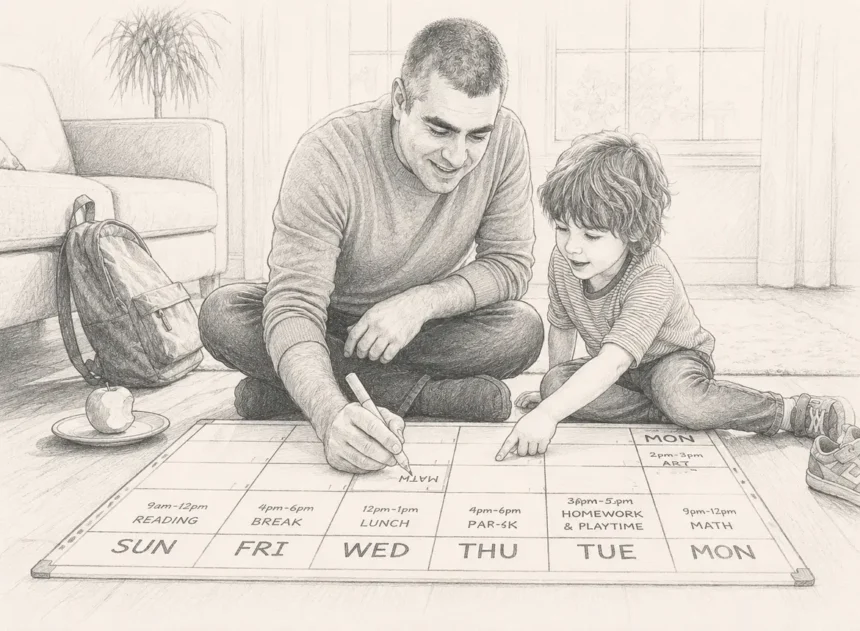
Most homework plans fail within the first week, not because the student was lazy or unmotivated, but because the plan was built around how homework was supposed to go instead of how it actually goes in a normal, imperfect week.
This guide is about building a plan that survives contact with a real week. Busy days, harder than expected assignments, and the occasional night where nothing goes according to schedule all get built in from the start, instead of being treated as failures later.
None of this requires a complicated system or an expensive planner. A single page and about twenty to thirty minutes on a Sunday is usually enough to set up a full week that actually holds together under normal, everyday conditions.
Why Most Homework Plans Fail Within a Week
A plan built around perfect conditions breaks the first time conditions are not perfect, which is most weeks. One long assignment, one bad night of sleep, or one unexpected event is usually enough to throw the whole thing off completely.
A few common reasons homework plans fall apart quickly:
- Every time slot is filled, leaving no room for anything to run long
- The plan assumes the same energy level every single day of the week
- Harder subjects get scheduled for the same low energy time every day
- There is no plan at all for what happens when something takes longer than expected
None of these mistakes are about effort or motivation. They are about the structure of the plan itself, which is something that can be fixed directly.
Start With What Actually Takes Time, Not What You Assume
Before building a new plan, it helps to know how long homework actually takes right now, not how long it feels like it should take. Most students are off by a significant amount in one direction or the other.
A simple way to find out: for one week, write down the actual start and end time for each homework session, without trying to change anything yet. This single week of honest data is worth more than any planning template on its own.
A few questions worth answering from that week:
- Which subject consistently takes longer than expected
- Which time of day homework actually starts, compared to when it was supposed to start
- How much time gets lost to breaks, distractions, or simply getting started
- Which days are consistently heavier than others
Building a plan around real numbers instead of guesses is the single biggest difference between a plan that works and one that does not.
The Weekly Planning Template
Once real numbers are in hand, a simple weekly layout covers most homework schedules without needing anything complicated.
| Day | Subject Focus | Time Block | Buffer |
|---|---|---|---|
| Monday | Heaviest subject first | Right after the lowest energy dip of the day | Fifteen minutes |
| Tuesday | Second heaviest subject | Same time as Monday if possible | Fifteen minutes |
| Wednesday | Lighter review and smaller tasks | Shorter block than other days | Ten minutes |
| Thursday | Heaviest subject again | Same time as Monday | Fifteen minutes |
| Friday | Wrap up and catch up on anything missed | Flexible timing | Twenty minutes |
This is a starting layout, not a fixed rule. The actual subjects and times should shift to match whatever the real weekly data from the previous section showed.
Building In Buffer Time on Purpose
Buffer time is the single most skipped part of most homework plans, and it is also the part that prevents the whole schedule from collapsing the first time something runs long.
A plan with no buffer treats every session as if it will take exactly the expected amount of time, every single time. Real homework does not work that way, and one long session without buffer time pushes every following session later for the rest of the night.
A simple rule that works well: add ten to fifteen minutes of buffer after each subject, and treat that buffer as available time rather than wasted time. If it is not needed, it becomes a short break. If it is needed, the schedule survives without falling apart.
How Long Different Types of Homework Actually Take
Different types of assignments follow different time patterns, which is useful to know when building a realistic plan.
| Task Type | Typical Time | Sign It Is Taking Too Long |
|---|---|---|
| Short practice problems | Fifteen to twenty five minutes | Rereading the same instructions more than twice |
| Reading assignments | Depends on length, roughly two minutes per page | Rereading the same paragraph repeatedly |
| Essay or writing tasks | Thirty to sixty minutes per draft | Staring at a blank page for more than five minutes |
| Long term projects | Best split across several short sessions | Trying to finish the entire thing in one sitting |
Recognizing these signs early makes it easier to decide whether to push through, take a short break, or ask for help, instead of continuing to struggle with the same approach.
A Subject by Subject Way to Plan Homework Time
Some subjects benefit from a specific approach to scheduling, beyond just picking a time slot.
| Subject | Best Scheduling Approach | Why It Works |
|---|---|---|
| Math | Short, frequent sessions rather than one long block | Skills fade quickly without regular practice |
| Science | Slightly longer blocks for lab reports and explanations | Concepts often need more setup before starting |
| English or essay | Split across two sessions, drafting and revising separately | Fresh eyes catch more on a second pass |
| History | Shorter sessions paired with review of the previous week | Connects new material to what already makes sense |
| Language learning | Short daily sessions instead of one weekly block | Consistency matters more than total time for language skills |
Matching the schedule to the subject, rather than using the exact same block length for everything, tends to produce noticeably better results without adding extra total time.
Does This Change by Grade Level
Younger students usually need a much simpler version of this plan, often just one or two short blocks a day with an adult helping to set the timer and check in. Older students can handle a full weekly layout with several subjects and more independent tracking.
The underlying principles stay the same at every age. What changes is who builds and adjusts the plan:
- Elementary level plans usually work best when a parent sets the schedule and checks in at the end of each block
- Middle school plans work well as a shared effort, with the student tracking time and a parent reviewing it weekly
- High school and college plans usually work best when the student builds and adjusts the plan independently, without needing daily check ins
A younger student’s plan should also include shorter blocks overall, since attention naturally holds for less time at younger ages, even for a subject that is genuinely enjoyable to them.
Working Around Sports, Clubs, and Other Activities
Most weekly homework plans have to work around something else already on the calendar, not instead of it. Practices, clubs, and other commitments are not obstacles to plan around after the fact. They are part of the actual schedule from the start.
A useful approach: build the homework plan around fixed activities first, then fill in the remaining time, rather than planning homework first and hoping activities fit around it afterward.
A few practical adjustments for busy activity schedules:
- Shorter, more frequent homework sessions on activity heavy days instead of one long block
- A slightly longer buffer on days that end later than usual
- Reviewing which specific days are consistently tightest, and moving lighter subjects to those days on purpose
- Accepting that some days may only allow for the heaviest priority task, with lighter tasks moved elsewhere
A plan that assumes every day has the same amount of available time rarely survives a season with regular practices or rehearsals in it.
Morning, After School, or Evening
The exact time of day chosen for homework matters almost as much as how long the session lasts. The same task can feel completely different depending on when it happens during the day.
| Time Window | Works Well For | Watch Out For |
|---|---|---|
| Right after school | Subjects that need to feel fresh in memory | Mental fatigue from a full day already behind |
| After a short break | Most subjects, once energy has partly recovered | Losing the whole evening if the break runs too long |
| Evening | Lighter review and reading tasks | Lower focus later in the day for anything difficult |
| Early morning | A quick review before school, if mornings allow it | Not enough time for anything requiring real focus |
Testing more than one window over a couple of weeks is often the fastest way to find out which one actually works, rather than assuming the most popular choice will automatically fit.
Deciding Whether to Start With the Hard Subject or the Easy One
This is one of the most common questions when building a plan, and the honest answer is that it depends on the student, not a single universal rule.
Starting with the hardest subject works well when energy and focus are highest right after school or right after a break. Starting with an easier subject works well when a small early win helps build momentum for a harder task afterward.
A simple way to decide which approach fits better:
- Try the hardest subject first for one week and note how the rest of the evening goes
- Try the easiest subject first for the following week and compare
- Use whichever pattern led to fewer stalled or abandoned sessions
There is no wrong answer here, only the one that matches how a particular student’s energy and focus actually work across a real evening.
Fitting Homework Help Tools Into the Plan Without Losing the Point
A weekly plan is also a good place to decide, ahead of time, how homework help tools fit into each session rather than deciding in the moment when a question feels hard.
A useful rule to build into the plan: attempt each task for the first chunk of its time block before using any outside help. If the attempt genuinely stalls before that block ends, help gets used for the remaining time, following the same try first approach that applies outside of any schedule.
Building this into the plan ahead of time removes a decision that otherwise has to be made fresh every single night, which is one less thing competing for attention when the actual homework starts.
What to Do When the Plan Falls Apart Midweek
Even a well built plan will not survive every single week without some kind of disruption. What matters is having a simple way to recover, rather than abandoning the plan entirely after one bad night.
A short recovery approach for a disrupted week:
- Identify which single day caused the biggest disruption and why
- Move only the missed tasks to the built in buffer time on a lighter day
- Avoid trying to catch up on everything in one long session
- Keep the rest of the week’s plan unchanged instead of rebuilding it from scratch
One disrupted day does not mean the whole plan failed. It usually just means that one day needs a small, specific adjustment rather than a complete redesign.
A Real Example Walkthrough
Here is what this looks like for an actual student.
A student tracks a real week and finds that math consistently takes forty minutes instead of the twenty minutes they expected, while reading assignments take far less time than assumed. History homework tends to get skipped most often, usually because it gets scheduled last, after energy is already low.
Using this information, the new plan moves math earlier in the evening, right after a short break following school, and gives it a full forty five minute block instead of twenty. History moves to right after math, while energy is still reasonably high, instead of being left for the end of the night.
Two weeks into the new plan, history assignments are no longer getting skipped, and math sessions are ending closer to on time instead of running long into the rest of the evening. Nothing about the total amount of homework changed. Only the order and the time allowed for each part did.
Common Mistakes When Building a Homework Plan
A few habits quietly undo an otherwise reasonable plan:
- Copying someone else’s schedule instead of building one around real, personal time data
- Filling every single minute, leaving no buffer for anything that runs long
- Scheduling the hardest subject during the lowest energy point of the day without testing alternatives
- Rebuilding the entire plan from scratch after just one disrupted day
- Treating the plan as fixed forever instead of adjusting it every few weeks as things change
None of these mistakes mean the planning approach itself does not work. They usually just mean one part of the plan needs a small adjustment rather than a full restart.
Reviewing and Adjusting the Plan Over Time
A homework plan is not something to set once and never touch again. Workloads change across a school year, and a plan built in September may not fit as well by January.
A short review every few weeks keeps the plan useful instead of letting it quietly stop matching reality. A few questions worth asking during that review:
- Which time blocks consistently run over, and which consistently finish early
- Has a new subject or heavier workload shown up that the current plan does not account for
- Is the buffer time actually being used, or is it either always empty or never enough
- Does the current wake up and bedtime schedule still match the plan built around it
Small adjustments made every few weeks keep a plan working far longer than a single perfect version built once and never revisited.
Frequently Asked Questions
How long should it take to build the first version of a weekly plan?
About twenty to thirty minutes, plus one week of tracking real homework times beforehand. The tracking week matters more than the planning session itself, since it provides the actual numbers the plan gets built around.
What if my homework load changes a lot from week to week?
Build the plan around a typical week rather than the busiest or lightest one, then use the buffer time to absorb the difference on heavier weeks. A plan built around the busiest possible week usually leaves too much empty time on lighter ones.
Should weekends be part of the plan too?
That depends on how much homework typically falls on a weekend. A lighter, more flexible version of the weekday plan usually works better than either ignoring weekends completely or scheduling them exactly like a weekday.
Is it better to use a written plan or a digital calendar?
Whichever one actually gets checked consistently. A written plan on a wall or notebook works well for students who respond to seeing it physically, while a digital calendar works better for students who already check their phone or computer regularly anyway.
What if the plan works for one subject but not another?
That is normal and expected. Different subjects often need different scheduling approaches, so adjusting only the part that is not working tends to work better than replacing the entire plan.
How much buffer time is actually enough?
Ten to fifteen minutes per subject covers most situations. Longer or more unpredictable subjects, like writing assignments, sometimes benefit from a slightly longer buffer than shorter, more predictable ones like short practice problems.
Should homework help tools be scheduled into specific time blocks?
Not as a strict rule, but deciding ahead of time how much of each session gets attempted alone before help is used tends to keep both the schedule and the learning on track.
What is the biggest sign a plan needs to be rebuilt instead of just adjusted?
If almost every day is consistently running over and buffer time is never enough, the underlying time estimates are probably off rather than the daily execution. That is usually a sign to redo the tracking week rather than keep adjusting small details.
How should the plan change during a season with heavy sports or activity commitments?
Build around the fixed activity times first, then fit homework into whatever real time is left, rather than trying to fit activities around an existing homework schedule. Shorter, more frequent sessions usually work better than long blocks during a busy season.
Is it worth testing different times of day, or should I just pick one and stick with it?
Testing is usually worth the extra effort in the first couple of weeks. The same task can take noticeably longer or shorter depending on the time of day it happens, so a short test period tends to save more time than it costs.
Do younger and older siblings need completely separate homework plans?
Usually yes, at least in terms of block length and how much independence is built in. Sharing the same general time window for homework can still work well, even when each child’s actual plan looks quite different in structure.
How to Build a Weekly Homework Plan That Actually Works How to Build a Weekly Homework Plan That Actually Works